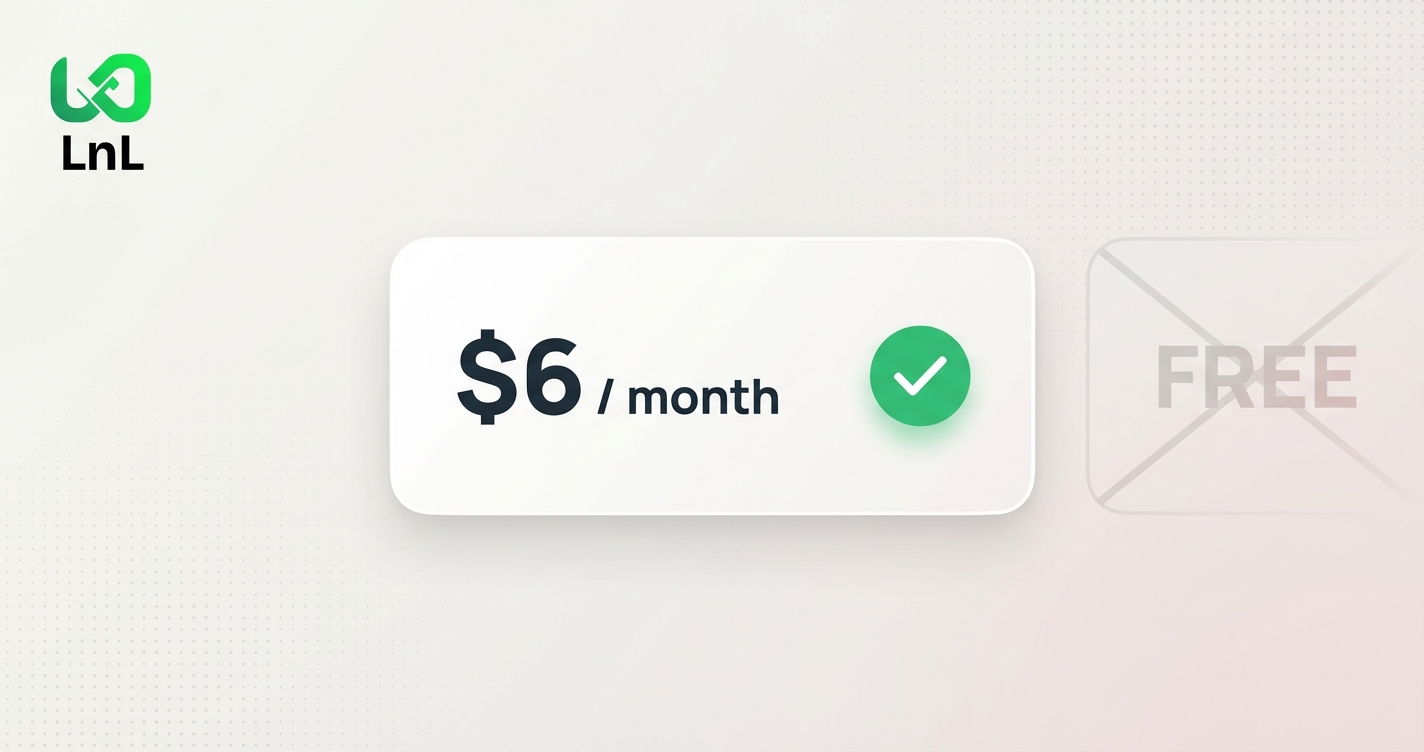
Free tiers are industry standard in this space. Linktree has a free plan. Bitly has a free plan. Short.io has a free plan. Even some of the more business-focused tools offer a free tier to get you in the door.
Links on Link doesn’t have one. The cheapest plan is $6/month. I want to explain why, because I think it’s the right call and I’d rather be upfront about it than hope you don’t notice.
Nothing in software is actually free. When a company offers a free tier, someone is paying for it: either through ads, data collection, transaction fees, feature restrictions designed to push you to upgrade, or by subsidising it from paid users.
Bitly’s free tier now shows an interstitial ad before every link redirect. Your audience clicks your link, they see a Bitly ad, then they land. That’s the business model for “free.” You’re not the customer: your audience’s attention is.
Linktree’s free tier includes unlimited basic links and lets creators sell products and courses, while paid plans add deeper customization, analytics, integrations, automation, and routing. Its business model also includes seller fees on lower plans: 12% on Free and 9% on Starter and Pro, with 0% reserved for Premium. That can be a reasonable way to start, but the cost changes as your needs and sales grow.
Short.io’s free tier is genuinely generous: 5 custom domains, 50k tracked clicks. But they make that work through volume on paid plans. Someone has to pay.
When I built Links on Link, the options were roughly:
Option 1 was a non-starter. Injecting anything on your links: ad or otherwise, without your explicit choice is the thing I was specifically trying to avoid.
Option 2 felt dishonest. Picking which features to hold back to create artificial upgrade pressure isn’t building a good product, it’s managing conversion rates.
Option 3 is a real model, but it creates a support burden for users who cost more than they contribute, and it means the free tier is always under pressure to be cut or monetised differently when growth slows.
Option 4 is simple. The product costs something. The something is $6/month. In exchange, nothing weird happens to your links.
The Creator plan isn’t a trial or a limited version of the real product. It’s the full thing for one person:
That covers what one person needs to start. The Pro plan at $15/month adds higher limits and the heavier tools: QR logos and frames, device and country targeting, A/B testing, webhooks, exports, and 0% fees on product sales.
There’s also a practical reason: free tiers attract abuse.
Link shorteners on free plans get used for spam, phishing, and all sorts of things the platform didn’t intend. At scale, that creates an ongoing moderation and infrastructure problem, and the bad links end up hurting the reputation of everyone using the platform: including you.
Requiring a paid account doesn’t eliminate abuse, but it raises the cost of it enough to significantly reduce the casual kind. It also means that if something does get through, we have the capacity to deal with it properly.
I think $6/month is a fair trade for a tool that doesn’t run ads on your links, doesn’t hold useful features hostage, and is built by someone who uses it themselves.
If that doesn’t work for your situation, it doesn’t: no hard feelings. But I’d rather be clear about what the product costs and why than pretend it’s free while figuring out how to extract value elsewhere.
Your discount will be automatically applied when you purchase a paid plan.
View plans