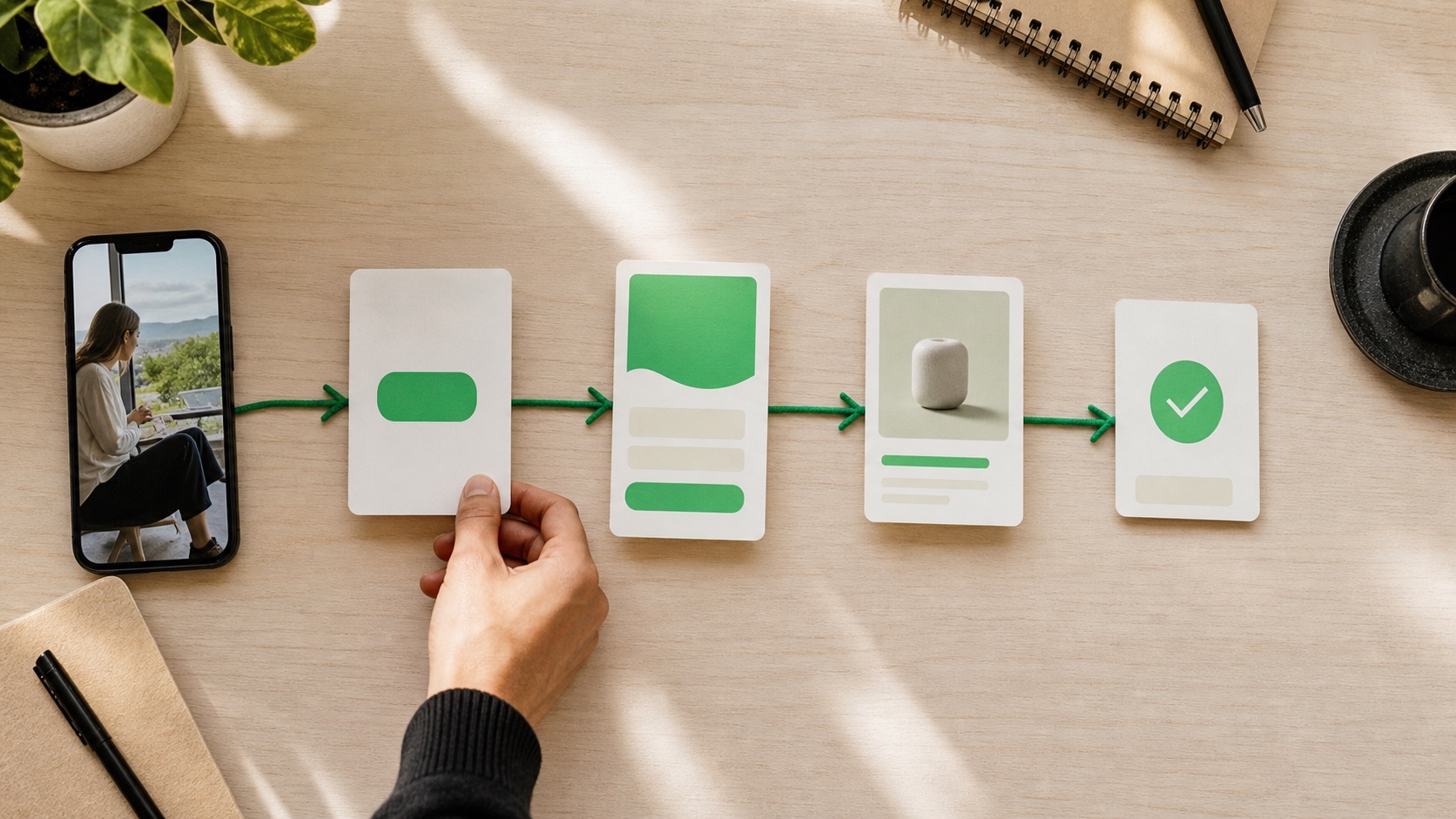
A bio link is not a funnel by itself. It is an address.
The funnel is the sequence that gives someone a reason to leave a social platform, choose a next step, understand an offer, and decide whether to buy.
For most independent creators, that sequence can stay simple:
content → profile link → focused page → offer → follow-up
Here is how to build each stage without turning your business into a maze.
The strongest route to a sale begins before the link. A post or video should make one relevant idea concrete.
Examples:
The product is a continuation of the content, not a surprise at the end.
Ask: if somebody liked this content, is the next step obviously relevant?
“Link in bio” describes a location. It does not give a reason to tap.
Use a call to action that connects the content to the destination:
Keep the promise consistent. If the content offers a free checklist, do not send the visitor to a page where the checklist is buried beneath merch, booking links, and five unrelated products.
Many bio pages are organized around the creator: my latest video, my newsletter, my store, my podcast, my gear. Buyers arrive with their own problem.
Organize the first screen around what they came to do.
A useful order is:
This does not mean every page needs one link. It means every campaign needs a recognizable priority.
Before buying a download, customers usually need to know:
Answer those questions near the buy button. Do not make the customer search a FAQ, social post, and checkout screen to reconstruct the offer.
For pricing, use the method in How to Price a Digital Product Without Guessing.
Not every visitor is ready to buy on the first visit. That does not mean you need an aggressive email sequence.
A useful follow-up can be:
Collect an email only when you can explain what will arrive next. “Join my newsletter” is weaker than “Get one practical portrait-lighting breakdown every Friday.”
Not every piece of content should point to a product.
| Visitor state | Appropriate next step |
|---|---|
| Discovering the problem | Educational guide or useful free resource |
| Comparing approaches | Case study, demonstration, or detailed product page |
| Ready to act | Direct product or booking link |
| Existing customer | Update, complementary product, or support resource |
Sending cold visitors straight to an expensive offer can fail. Sending ready buyers through a long lead magnet sequence can also fail. The shortest appropriate path is usually the best one.
One permanent bio-page URL can support several campaigns when the page is updated carefully. For more precise measurement, use tagged or short links for individual placements.
For example:
yourdomain.com/portrait for a portrait series;yourdomain.com/interview for career content;yourdomain.com/podcast for show notes;Each route can redirect to the relevant section or page. Keep the naming human-readable so you can say it aloud and recognize it in reports.
YouTube currently lets creators add channel profile links, while clickability in descriptions depends on placement and channel access. Its official link-sharing guide is worth checking before planning a campaign. Platform rules change; verify the current placement rules for every network you use.
Track a small set of conversion points:
If content gets reach but few profile visits, fix the content-to-profile handoff. If the page gets visits but few offer clicks, fix the page hierarchy or message. If checkouts start but purchases do not complete, inspect payment and trust friction.
The detailed guide to these numbers is Link-in-Bio Analytics: 7 Metrics That Actually Change What You Do.
That is enough infrastructure for many creator businesses. Add complexity only when the current path is already producing evidence that another branch is needed.
Links on Link is our product. It combines branded links, bio pages, email capture, digital product delivery, courses, and analytics. It does not currently replace memberships or advanced email automation. Compare the fit and fees in our 2026 platform guide.
Your discount will be automatically applied when you purchase a paid plan.
View plans